Dr. Steven Banham identified steep rock waves on Mars from research at the Open University in the UK. The formations offer new insight into ancient wind storms and early air pressure on the planet. The discoveries come from images taken by a robotic rover.
NASA sent its first wheeled vehicle to the planet in 1997. The Curiosity craft has now travelled nearly 24 miles since 2012 as of October 2026. Dr. Steven Banham began working on mission shifts in December 2024.
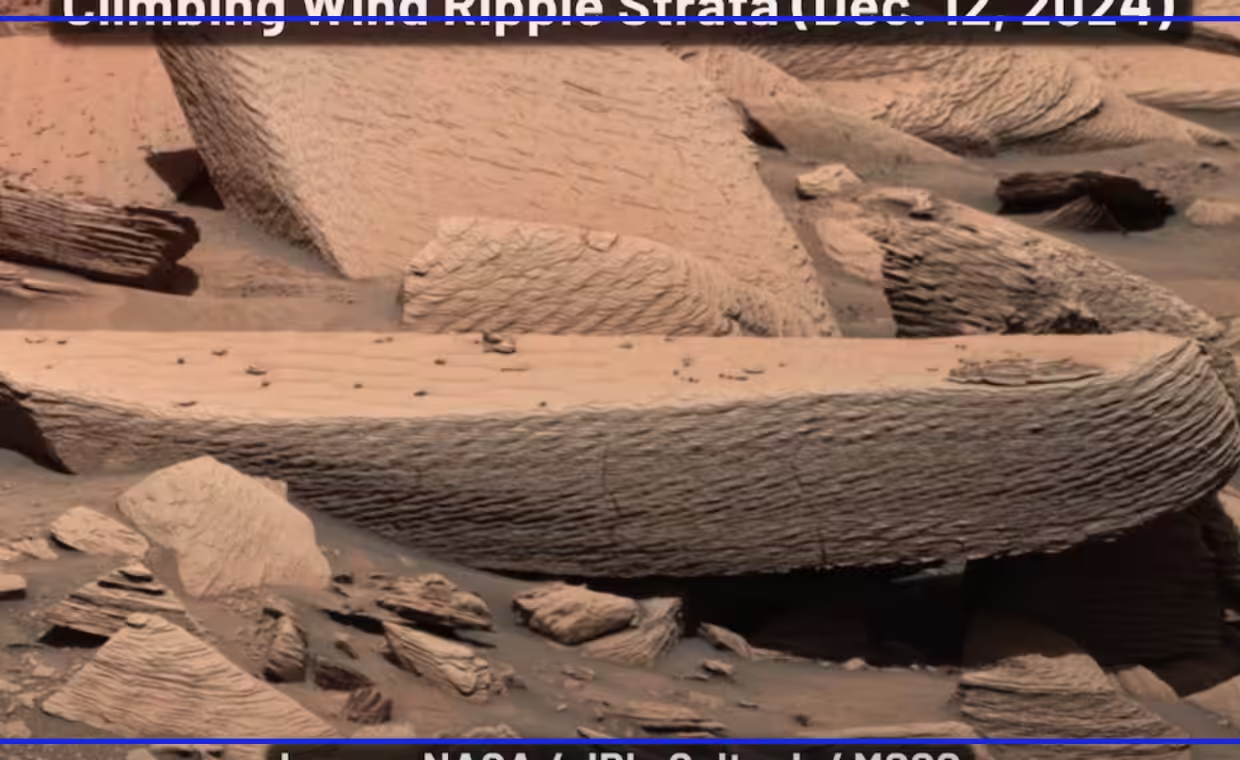
The vehicle stopped after driving 20 or 30 metres across the ground. Operators reviewed black and white photos from the site. Banham said the team noticed unusual undulating shapes on the rock surfaces.
The vehicle captures a forward picture at the end of each work cycle. Operators use these photos to chart the next move. Researchers spotted stacked patterns in the corner of one view and named the area Jawbone Canyon.
“They didn’t look like the characteristic ripples that you normally see, where the ripples migrate along in the current, and over time they can build up and form layers. They looked like they climbed at a very steep angle.”
The stone features were preserved inside Martian sandstone. Scientists estimate the structures formed 3.5 to 3.8 billion years ago. The grains measured one-tenth to one-half millimetre in size.
Banham studied river systems and earned his doctoral degree in the red sands of Utah. He said Earth processes translate directly to events on Mars. Sediment settled rapidly behind natural obstacles during heavy wind flows.
“When this happens, then you have all this sand settle very quickly, and it causes these ripples to sort of climb at a supercritical angle.”
Air currents require high speeds to move and suspend dense rock grains. Banham stated that storm levels of wind were needed to carry that sediment load. Thinner atmosphere demands faster movement to lift particles.
Mars holds around five millibars of air pressure today. Banham questioned whether ancient storms required thicker air to create the shapes. Higher air pressure existed during periods when life had the strongest chance to survive.
“It’s special to be able to sort of recognize things that happened over the course of an hour, like billions of years ago… and it just makes Mars seem more like a regular planet, and not just like a science fiction object.”
Sedimentology examines how sand, soil and rock settle over time across landforms. Scientists track these layers to reconstruct historic climates and weather events. Robotic rovers collect surface photography to help geologists evaluate distant terrain.
Astronomers around the globe have tracked the planet since ancient Egypt. Space probes have beamed photos from the red soil for half a century. Banham continues testing wind models from the UK to evaluate Martian air history.